02Earn
New revenue from
demand response
Equipment that uses power starts earning from it.
¥10M
per plant, per year*
* Estimate for cold storage equipment. Actual payments are not guaranteed.
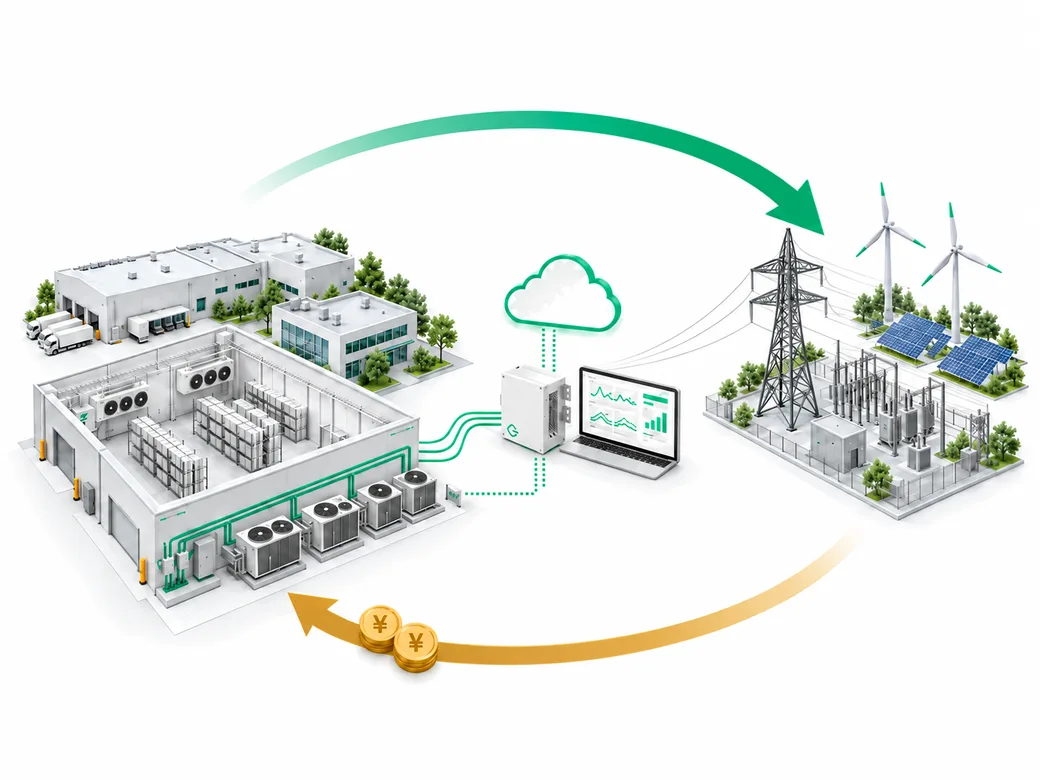
Adjusting power demand
Refrigeration
& HVAC equipment
Power market

DR payment to you
Power held back becomes
supply capacity
We optimally control refrigeration, cold storage and HVAC equipment in line with regional grid conditions, creating power resources from demand-side equipment through demand response. As supply capacity, these resources help stabilise the regional grid and increase the share of renewable energy. You receive the payment in return.
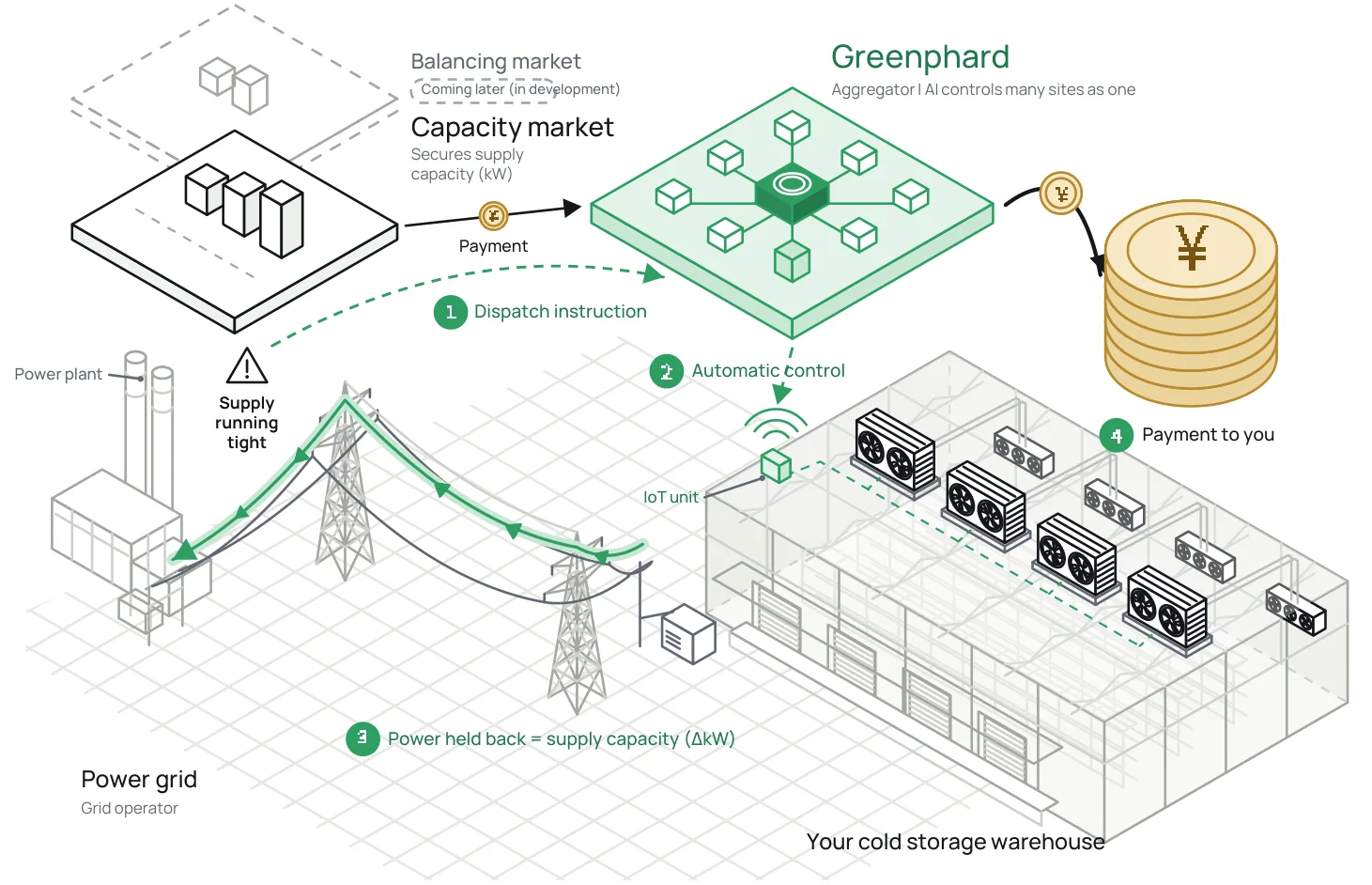
STEP 01A dispatch instruction arrives
When supply is expected to run tight, the grid operator issues a dispatch instruction at least 3 hours ahead. Up to 12 events a year, 3 hours each.
STEP 02AI holds back operation
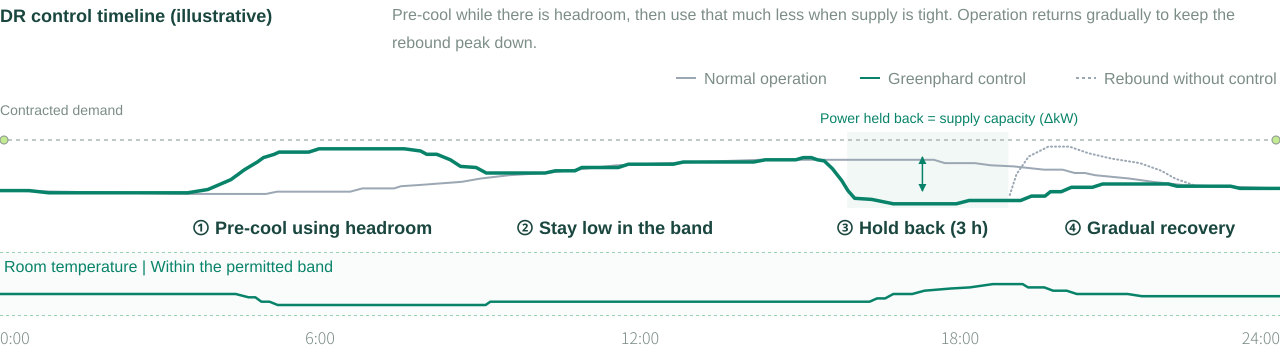
Pre-cooling and timing adjustments allow operation to be held back for the designated 3 hours, automatically and within the permitted temperature band.
STEP 03Power held back becomes capacity
The reduction from normal usage (the baseline), measured in ΔkW, is valued as supply capacity supporting the grid, just as a power plant does.
STEP 04The payment becomes your revenue
Greenphard passes capacity-market payments on to you, as a payment or a service-fee discount, depending on your plan.
Participation at a glance
- Dispatch notice at least 3 hours ahead
- 3 hours per event, up to 12 a year
- Rooms stay within the permitted band
- No on-site operation needed
Cool when there is headroom.
Use less when the grid is tight.
Held-back demand becomes
supply capacity.
We optimise operation based on equipment conditions and the power market. Pre-cooling while contracted demand has headroom lets equipment use less power within the permitted band when supply is tight. That reduction is offered as supply capacity to help balance the grid.
Temperature band
Upper and lower temperature limits are monitored room by room; control stays inside the permitted band.
Contracted demand
30-minute demand forecasts are checked against contracted demand so pre-control stays below it.
Defrost
Defrosting causes a sharp temperature rise. Control takes that timing into account.
On-site decisions come first
In an emergency, equipment can be operated on site.
- Day ahead
- Next-day operating plan based on grid forecasts and market prices
- 3+ hours ahead
- Dispatch instruction received; plan confirmed
- Every 30 minutes
- Demand forecast updated; hold-back and recovery decided
- Real time
- Compressor frequency, start/stop and staging adjusted

The role of DR.
Where it stands today.
01 Global trend
Short-term flexibility needs could roughly triple by 2035
An IEA analysis projects that short-term flexibility needs in advanced economies will reach around three times their 2024 level by 2035. Batteries and DR are expected to provide roughly half.
02 Japan’s policy
The 7th Strategic Energy Plan recognises the importance of DR
Renewables are projected to account for 40–50% of electricity in FY2040. Policy materials from March 2026 schedule small-scale resources’ entry into the balancing market for FY2026, subject to system modifications and other preparations.
03 Japan’s market
Around 6.39 GW of dispatch-instruction resources, including DR, cleared
This is the capacity cleared for FY2028 delivery. DR accounted for approximately 65.6% of awarded capacity in the FY2023 balancing-capacity tender.
- 24 sites
- At the 2025 capability test
- 10MW
- At the 2025 capability test
- 200MW
- Target for 2030
Sources: IEA analysis cited in ANRE’s report on distributed energy (19 December 2025); the 7th Strategic Energy Plan; ANRE’s Policy Trends Related to ERAB (March 2026). The approximately 6.39 GW refers to 6,395,019 kW of dispatch-instruction resources cleared in the main auction for FY2028. DR accounted for 2.522 GW of the total 3.844 GW awarded in the FY2023 balancing-capacity tender (about 65.6%). Our 24 sites and 10 MW refer to the 2025 capability test; 200 MW is our target for 2030. A balancing-market product is in development.
Frequently Asked Questions
What is demand response, and who receives the payment?
Demand response reduces electricity use when supply is tight, providing capacity to the grid. We adjust frequency, start/stop timing and the number of units running. For dispatchable demand resources in the capacity market, instructions arrive at least 3 hours in advance, with each event lasting 3 hours and up to 12 events per year. You can receive the payment or apply it as a service-fee discount. Settlement timing and method depend on the contract.
Are cold-room and indoor temperatures protected?
Control operates only within the permitted temperature band agreed with you. If a threshold is exceeded, automatic alerts by email and automated voice call notify both you and Greenphard, 24 hours a day. On-site equipment operation always takes priority over automatic control. Pre-cooling for demand response is performed only at sites that have agreed to it.
* ¥10M per plant per year is an estimate for cold storage equipment, not a guaranteed payment. Payments vary with clearing prices, contracted capacity and response performance. Participation requires high-voltage supply or above (contracted demand of at least 50 kW) and other conditions, under a separate DR contract. Up to 12 events can occur annually; in practice, there are usually only a few.
* Notice time, duration and frequency follow Japan’s FY2026 capacity-market requirements for dispatch-instruction resources. Pre-cooling is carried out only at sites that agree to it. Payments can be received directly or as a fee discount. Diagrams are illustrative.
* Payments vary with market clearing prices, contracted capacity and response performance in capability tests and dispatch events, and are not guaranteed. They may be reduced if a site fails to respond. Payments pass from the market operator through an aggregation coordinator or similar entity and Greenphard to you. A balancing-market product is in development.
* Demand response is not part of the function grades and requires a separate DR contract. A DR agent or other intermediary may sit between Greenphard and you; settlement then takes place through that company. DR alone does not absorb all renewable variability.